Male Filler Treatments: Masculine Facial Enhancement

The most common thing men say before their first filler appointment is some version of “I don’t want to look like I’ve had anything done.” And honestly? That’s the right instinct. It’s also exactly what good dermal fillers for men are designed to produce, not a treated face, not an altered one, but your face doing what it was doing five or ten years ago before time quietly started making edits you didn’t approve.
The problem isn’t that men shouldn’t want injectable fillers. It’s that most of the information out there about fillers was written with a woman’s face as the default, which is why so many men either dismiss the conversation entirely or walk away from their first consultation feeling like the treatment was built for someone else. It wasn’t. But the approach has to be different — and here’s why.
Men’s Faces Don’t Age on the Same Timeline, Until They Do
Male facial aging has a specific pattern that catches most men off guard. Because men typically have denser bone structure and thicker soft tissue than women, the visible effects of aging often develop more slowly in the first couple of decades. The trade-off is that when the change does come, it tends to arrive with less warning and more impact.
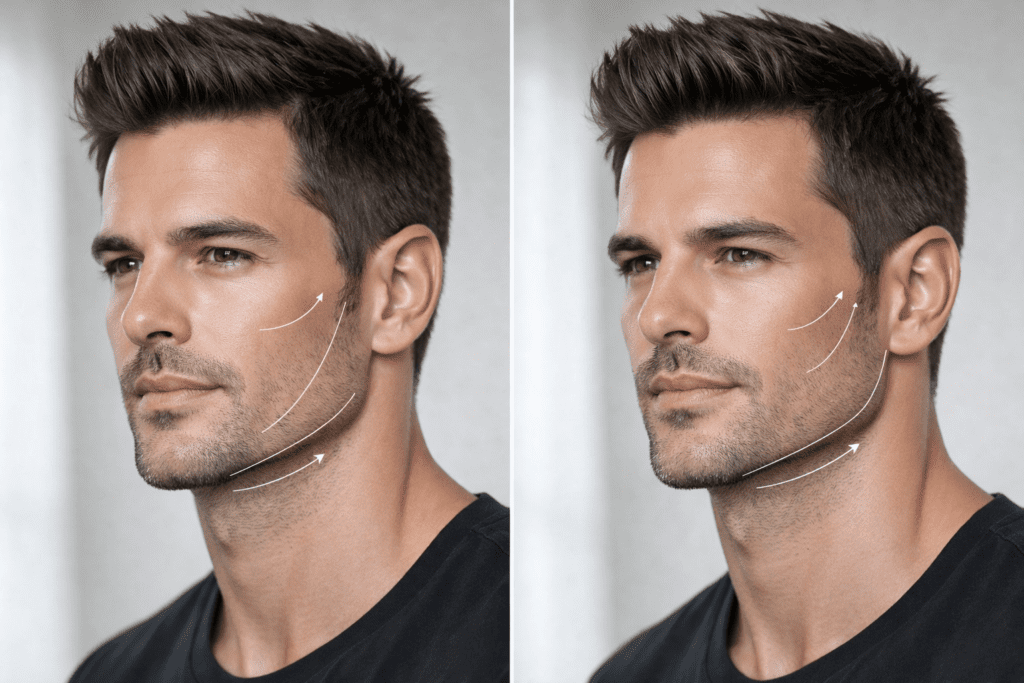
What actually happens is this: the structural fat pads in the face — which give it dimension, projection, and shape — gradually migrate downward and diminish in volume. The jawline loses its definition. The chin loses forward projection. The midface flattens. Hollows deepen under the eyes in ways that make a well-rested face read as permanently tired. And because these are structural changes rather than surface changes, no skincare routine, diet plan, or amount of sleep addresses them. The architecture shifted. The only thing that restores architecture is volume — placed precisely, in the right amounts, by someone who understands what masculine facial geometry is actually supposed to look like.
That last part is where most conversations about male fillers go wrong.

The Difference Between Masculine Enhancement and Over-Treatment
A good provider approaches a male face with an entirely different aesthetic framework than they use for female patients. The goal is not softness. It’s not roundness. It’s not the lifted, volumized look that defines a lot of female filler work. For men, the aesthetic targets are structural: angular definition, projection, sharpness at the jaw and chin, a midface that reads as strong rather than full.
This requires restraint as much as skill. The most common filler mistakes on male faces come from over-treating, too much volume placed in the wrong planes, producing a pillowy, obvious result that reads as “done” from across the room. Masculine facial enhancement done correctly looks like nothing happened except that the person in front of you appears sharper, more rested, and more like themselves than they did the last time you saw them.
At Vigour, our providers are guides, not order takers. We’re going to tell you what your face actually needs, how much of it, and why. And sometimes the most important thing we say is less.
Where Fillers Go in a Male Face, and What They’re Actually Doing There
Every zone of the face ages differently and responds to filler differently. Here’s how we think about each one:
Jawline and chin are the structural foundation of masculine aesthetics. Facial fillers placed along the mandibular border sharpen a softened jaw, create a cleaner angle, and restore the separation between face and neck that aging gradually blurs. Chin filler adds forward projection, improving the profile balance between the chin and nose. Together, these two areas produce the most impactful shift in overall masculine appearance, and almost no one can identify specifically what changed. They just know you look better.
Cheek fillers in men are not about volume. Full stop. The goal is restoring the malar prominence — the angular projection just below the eye — that gives the midface its geometry. Deflation here creates a gaunt, tired appearance. Restoring it with small, precise placement brings back sharpness and energy without adding roundness that feminizes the face. Conservative is the word. Always.
Under-eye hollows are the area men are most surprised to have addressed, and most grateful for afterward. The tear trough hollow that deepens with age creates a persistent tired look that sleep, hydration, and eye cream will never fix, because it’s a volume problem, not a skin problem. A small amount of hyaluronic acid filler placed carefully beneath the lower lid smooths the shadow and immediately changes how the eyes read, awake, engaged, present.
Lips are the most misunderstood treatment in male aesthetics. Most men don’t need more volume. They need better definition, a cleaner border, improved hydration, correction of subtle asymmetry that’s become more pronounced with age. Well-placed lip fillers should make no one think about lips at all. They should just make the face look more balanced.
The Questions Men Actually Ask, And the Honest Answers
Here’s what we hear most often in male filler consultations, and what we actually tell people:
- “Will it look obvious?” Only if it’s done wrong. The standard of care for male fillers at Vigour is that you should look better, not different. If someone is asking what you had done, that’s a failure of execution.
- “Does it hurt?” Most areas are tolerable. The jawline and chin are typically the most comfortable. Under-eye treatment can be more sensitive. Topical numbing is applied beforehand, and most injectable fillers contain lidocaine in the formulation, which numbs the area as treatment progresses.
- “How long does it last?” Depends on the product, the area, and your metabolism. Jawline and chin results often last twelve to eighteen months or longer. Higher-movement areas like the lips tend to metabolize faster. Your provider will give you a realistic expectation specific to your treatment plan.
- “What if I don’t like it?” Hyaluronic acid fillers are reversible. An enzyme called hyaluronidase can dissolve them quickly if needed. This is one of the primary reasons hyaluronic acid fillers remain the most used product in aesthetic medicine — the reversibility creates a safety net that makes first-time treatment far less daunting.
- “Am I a good candidate?” If you’re looking at your face and noticing structural changes that bother you — a jaw that’s softer than it used to be, a face that looks tired when you’re not — you probably are. The consultation will tell you for certain.
Why Starting Earlier Matters More Than Most Men Realize
There’s a version of male filler treatment that’s reactive, addressing changes that have already become significant. And there’s a version that’s proactive, maintaining the structural qualities of the face before they’ve deteriorated enough to require larger intervention.
Men who begin in their late thirties or early forties, when the first signs of structural change are appearing, typically need smaller volumes, fewer appointments, and produce results that look completely natural because the baseline hasn’t shifted dramatically yet. Men who wait until their fifties or sixties aren’t disqualified from great results, but the work is more complex, requires more product, and takes more careful management to avoid the “done” look that everyone wants to avoid.
At Vigour Aesthetics + Wellness, we’d rather be your long-term guide through this than the team you call when something has gone far enough to feel urgent. The best time to have the conversation is before you think you need to.
Your Face, Sharper
Dermal fillers for men at Vigour Aesthetics + Wellness in Albany, NY are not about changing who you are. They’re about making sure what shows up in the mirror accurately represents the person you actually are — sharp, present, and not ten years older than you feel. If you’ve been curious and not sure where to start, the consultation is the answer. We’ll look at your face, listen to your concerns, and give you an honest picture of what’s possible and what’s actually worth doing. Book yours today.